-1.png?width=193&height=42&name=Shadow%20HQ%20Logo%201%20(2)-1.png)

How to Create a Cyber Crisis Management Plan Before an Attack Happens
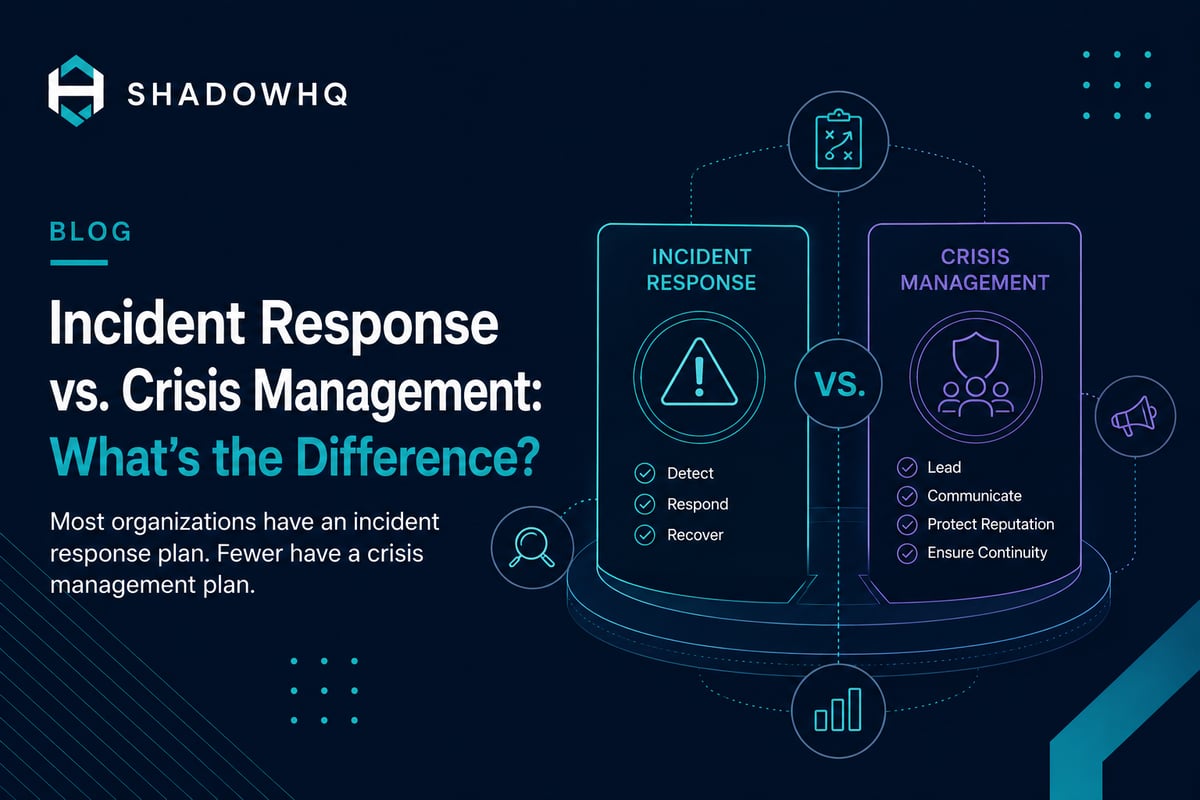
Most organizations have an incident response plan. Fewer have a crisis management plan.
And even fewer understand the difference between the two.
As cyberattacks become more disruptive, organizations are discovering that technical response alone is no longer enough. While security teams may be focused on containing the threat, business leaders are making decisions that affect customers, operations, employees, regulators, and stakeholders.
In other words, they are managing a crisis.
Understanding the distinction between incident response and crisis management is essential for building a modern cyber resilience strategy.
Because during a major cyber event, success depends on both.
What Is Incident Response?
Traditional incident response is the structured process organizations use to detect, investigate, contain, eradicate, and recover from a cybersecurity incident.
The primary goal of incident response is to stop the attack, understand what happened, and restore affected systems as quickly as possible.
Incident response activities typically include:
- Threat detection
- Incident investigation
- Forensic analysis
- Containment
- Eradication
- Recovery
- Lessons learned
These activities are usually led by:
- Security Operations Center (SOC) teams
- Security analysts
- Incident responders
- Digital forensics teams
- IT operations teams
At its core, incident response seeks to answer one critical question: how do we stop the attack?
What Is Crisis Management?
Crisis management is the process of coordinating people, communications, decisions, and business activities during a disruptive event.
Unlike incident response, which focuses on the technical aspects of an attack, crisis management focuses on protecting the organization and minimizing business disruption.
A crisis management team may be responsible for:
- Executive decision-making
- Stakeholder communications
- Regulatory notifications
- Business continuity
- Employee communications
- Customer communications
- Reputation management
- External partner coordination
Participants often include:
- Executive leadership
- Legal counsel
- Communications teams
- Human resources
- Operations leaders
- Risk management teams
- Security leadership
The key question crisis management seeks to answer is: how do we manage the business through this event?
Incident Response vs. Crisis Management: Key Differences
Although the two disciplines work closely together, they serve different purposes.
|
Incident Response |
Crisis Management |
|
Technical discipline |
Business discipline |
|
Focuses on the threat |
Focuses on organizational impact |
|
Led by security teams |
Led by leadership teams |
|
Investigates and contains attacks |
Coordinates decisions and communications |
|
Measures technical recovery |
Measures business resilience |
|
Concerned with systems and data |
Concerned with people, operations, and stakeholders |
A simple way to think about it is this:
Incident response manages the attack. Crisis management manages the consequences.
Organizations need both to respond effectively to modern cyber incidents.
When Does a Cyber Incident Become a Crisis?
Not every cyber incident becomes a crisis.
A phishing email that is quickly contained may require incident response but little involvement from the broader business. A widespread ransomware attack, however, is a different story.
Cyber incidents typically become crises when they begin affecting the organization beyond the security team. Common indicators include:
- Critical system outages
- Operational disruption
- Customer impact
- Regulatory reporting obligations
- Significant financial exposure
- Media attention
- Executive involvement
- Third-party coordination
At this point, technical response remains important—but it is no longer sufficient.
The organization must begin coordinating decisions, communications, and business operations alongside the technical investigation.
This is where crisis management becomes essential.
Why Organizations Often Focus Too Much on Incident Response
Historically, cybersecurity programs have been built around detection and response.
Organizations invest heavily in:
- Security tools
- Monitoring technologies
- Threat intelligence
- Incident response plans
- Forensic capabilities
All of these investments are important.
However, many organizations spend far less time preparing for the operational challenges that emerge during a major cyber event.
Common gaps include:
Security-Centric Planning — Response plans often focus exclusively on technical teams, leaving business stakeholders without clear guidance.
Undefined Roles and Responsibilities — Legal, communications, HR, and operational leaders may not understand their responsibilities during a cyber crisis.
Communication Challenges — Organizations frequently assume email, collaboration platforms, and identity systems will remain available throughout an incident. Increasingly, that assumption is proving false.
Decision-Making Bottlenecks — Without predefined leadership structures, critical decisions can become delayed when time matters most.
These challenges often have a greater impact on recovery than the technical response itself.
How Incident Response and Crisis Management Work Together
The most resilient organizations do not choose between incident response and crisis management.
They integrate both.
Think of these functions as two interconnected teams working toward the same objective.
The Incident Response Team
Responsible for:
- Investigating the incident
- Containing the threat
- Restoring systems
- Preserving evidence
- Identifying root causes
The Crisis Management Team
Responsible for:
- Coordinating stakeholders
- Managing communications
- Supporting leadership decisions
- Maintaining business continuity
- Minimizing organizational disruption
Both teams require information from one another. Incident responders provide technical insight. Crisis managers provide organizational direction. Together, they help the organization navigate the event more effectively.
The most successful cyber responses occur when technical responders and business leaders operate as a unified team.
The Role of Cyber Incident Command
As cyber incidents become more complex, organizations are increasingly adopting a structured approach to coordinating response efforts. This approach is often referred to as cyber incident command.
Cyber incident command serves as the bridge between incident response and crisis management. It provides the framework needed to coordinate:
- Technical responders
- Executive leadership
- Legal teams
- Communications teams
- Operations leaders
- External partners
Rather than operating in separate silos, stakeholders work from a shared operational picture. Incident command provides:
- Coordination
- Accountability
- Visibility
- Communication
- Decision support
In many organizations, cyber incident command is becoming the mechanism that aligns technical response with business crisis management.
Why Out-of-Band Communications Matter
Both incident response and crisis management depend on one critical capability: Communication.
Unfortunately, modern attacks increasingly target the very systems organizations rely on to communicate. During a significant cyber incident, organizations may lose access to:
- Collaboration platforms
- Identity systems
- Corporate messaging tools
Without communication, neither incident response nor crisis management can function effectively. This is why many organizations are adopting out-of-band communication capabilities that operate independently from primary business systems.
These platforms provide a secure way to coordinate stakeholders, communicate decisions, and manage response activities when traditional channels are unavailable or untrusted.
How ShadowHQ Helps Bridge Incident Response and Crisis Management
Most cybersecurity tools are designed to support technical response activities. ShadowHQ was built to help organizations coordinate the broader response.
As an Out-of-Band Cyber Incident Command Platform, ShadowHQ helps organizations bring together incident responders, executives, legal teams, communications personnel, and operational stakeholders within a secure environment designed specifically for cyber crisis management.
With ShadowHQ, organizations can:
Activate Stakeholders Quickly — Notify and engage response teams through independent communication channels, even when primary systems are unavailable.
Coordinate Incident Command Operations — Manage playbooks, tasks, war rooms, escalation procedures, and response activities from a centralized platform.
Improve Executive Visibility — Provide leadership teams with real-time awareness of response activities, stakeholder engagement, and recovery progress.
Strengthen Preparedness — Conduct tabletop exercises, validate communication workflows, and operationalize cyber incident command before an incident occurs.
By connecting technical response teams with business stakeholders, ShadowHQ helps organizations move from fragmented response efforts to coordinated crisis management.
Frequently Asked Questions
Is incident response the same as crisis management?
No. Incident response focuses on technical investigation and remediation, while crisis management focuses on coordinating people, communications, and business activities during a disruptive event.
Who leads crisis management during a cyber incident?
Crisis management is typically led by executive leadership with support from legal, communications, operations, risk management, and security teams.
Does every cyber incident require crisis management?
No. Smaller incidents may only require technical response. Crisis management becomes necessary when incidents significantly impact business operations, customers, regulators, or stakeholders.
What is cyber crisis management?
Cyber crisis management is the process of coordinating organizational response activities during a significant cybersecurity event to minimize disruption and support business continuity.
How does cyber incident command support crisis management?
Cyber incident command provides the structure, communication, visibility, and coordination needed to align technical responders and business leaders throughout a cyber crisis.
Cyber Incidents Are No Longer Just Security Events
For years, cybersecurity programs focused primarily on detection, investigation, and recovery. Those capabilities remain essential. But today's cyber incidents often extend far beyond the security team.
They affect operations.
They impact customers.
They create legal obligations.
They influence reputation.
They require leadership decisions.
That is why incident response alone is no longer enough. Organizations need the ability to manage both the attack and the business consequences that follow. The organizations that prepare for both will be better positioned to respond, recover, and maintain control when the next cyber crisis occurs.
Download our Cyber Incident Readiness Checklist to stay ready for what comes next.
.png?width=600&height=331&name=Image%20(1).png)