-1.png?width=193&height=42&name=Shadow%20HQ%20Logo%201%20(2)-1.png)

Incident Response vs. Crisis Management: What's the Difference?
Most organizations have an incident response plan. Far fewer have a cyber crisis management plan.
That distinction matters more than ever.
Today's cyber attacks don't just affect IT systems. They disrupt operations, impact customers, attract media attention, trigger regulatory obligations, and force executives to make critical decisions under enormous pressure.
While your security team may know how to contain malware or investigate a compromised account, who decides whether to shut down production? Who approves customer communications? Who speaks to the board? How do you coordinate teams if Microsoft Teams, Slack, or email are unavailable?
Those questions aren't answered by an incident response plan.
They're answered by a cyber crisis management plan. In this guide, we'll walk through the essential steps to building a plan that helps your organization respond faster, communicate clearly, and minimize business disruption before a cyber attack ever occurs.
What Is a Cyber Crisis Management Plan?
A cyber crisis management plan is a documented framework that helps an organization coordinate its response to a significant cyber incident from a business perspective—not just a technical one.
Where an incident response plan focuses on identifying, containing, and eradicating threats, a crisis management plan answers questions like:
- Who is responsible for leading the response?
- How will executives make decisions?
- How will employees, customers, regulators, and partners be informed?
- What business functions must continue operating?
- How will teams coordinate if normal communication channels are unavailable?
Think of incident response as solving the technical problem. Crisis management is about helping the business continue functioning while that technical work takes place. If you're still unclear about the distinction, our guide on Incident Response vs. Crisis Management: What's the Difference? explores how the two disciplines complement one another during a cyber incident.
Why Every Organization Needs a Cyber Crisis Management Plan
Cyber incidents have become business events.
A ransomware attack can halt manufacturing. A cloud outage can interrupt customer service. A compromised identity provider can leave thousands of employees unable to work. Even relatively contained incidents often require involvement from:
- Executive leadership
- Legal
- Human Resources
- Communications
- Customer Success
- Compliance
- Operations
- Finance
Without clear coordination, organizations frequently lose valuable time determining who owns decisions, who needs to be informed, and what actions should happen next.
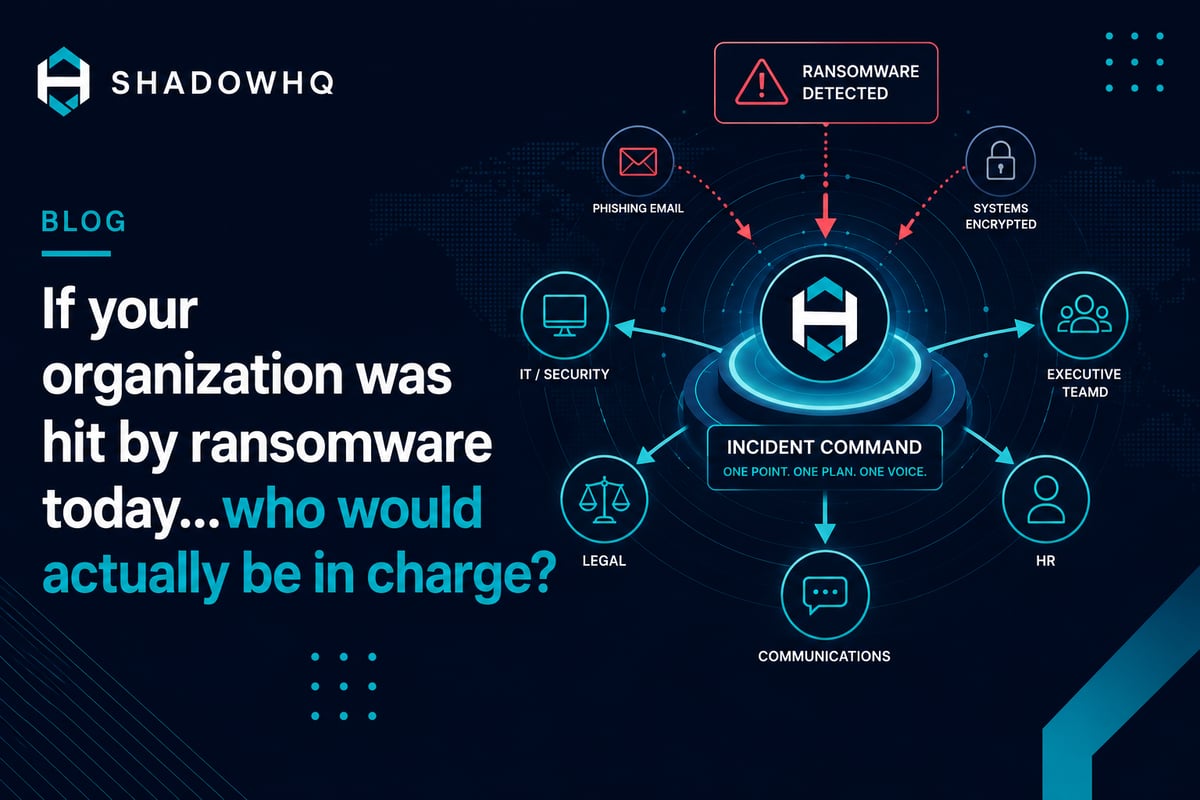
This is why many organizations are adopting an incident command model—assigning a dedicated leader responsible for coordinating people, decisions, and communications throughout the response.
Step 1: Define What Constitutes a Cyber Crisis
Not every security incident requires activating your crisis management team. Your plan should clearly define what elevates an incident into a business crisis. Common triggers include:
- Significant operational disruption
- Customer-facing service outages
- Confirmed ransomware
- Large-scale data exposure
- Regulatory reporting requirements
- Executive or board involvement
- Media attention
- Safety or public welfare concerns
Establishing objective escalation criteria ensures teams respond consistently and avoid wasting valuable time debating whether the situation is "serious enough."
Step 2: Establish Clear Incident Command
One of the most common reasons organizations struggle during cyber incidents is uncertainty around leadership.
When everyone is responsible, no one is truly leading. Every cyber crisis management plan should identify an Incident Commander with the authority to coordinate the response and keep teams aligned.
Depending on the organization, additional roles may include:
- Technical Response Lead
- Executive Sponsor
- Communications Lead
- Legal Counsel
- HR Representative
- Business Operations Lead
- Customer Communications Lead
- Compliance Officer
Each role should include:
- Responsibilities
- Decision-making authority
- Backup personnel
- Contact information
The goal isn't creating bureaucracy—it's eliminating confusion.
If you're considering how this role fits into your organization, our article What Is an Incident Commander in Cybersecurity? explains why dedicated leadership has become essential during modern cyber incidents.
Step 3: Build Your Crisis Communications Plan
Communication often becomes the most difficult part of managing a cyber crisis. Employees need updates.
Customers expect transparency. Executives require accurate information. Regulators may require formal notification. The media may begin asking questions. Your crisis management plan should outline:
- Internal communication workflows
- External communication procedures
- Stakeholder notification priorities
- Approval processes
- Spokesperson responsibilities
- Pre-approved message templates
Preparing these materials before an incident dramatically reduces confusion and ensures messaging remains accurate and consistent.
For a deeper dive, see our Cyber Crisis Communications Playbook, which outlines practical communication strategies for every phase of a cyber incident.
Step 4: Assume Your Primary Communication Tools Will Fail
This is one of the most overlooked parts of crisis planning. Many organizations build communication plans that rely entirely on the systems most likely to become unavailable during a cyber attack.
Email.
Microsoft Teams.
Slack.
VPN access.
Corporate directories.
Identity providers.
Any of these systems may be unavailable, compromised, or intentionally taken offline during an incident. That's why modern cyber preparedness includes out-of-band communications—a secure, independent communication platform that allows response teams to coordinate outside their primary IT environment.
If your crisis communications plan depends entirely on corporate infrastructure, it's worth asking what happens if that infrastructure becomes part of the incident.
Step 5: Develop Playbooks for Common Scenarios
Rather than creating one enormous crisis document, develop focused playbooks for your most likely scenarios. These might include:
- Ransomware
- Business email compromise
- Data breach
- Insider threat
- Cloud service outage
- Third-party compromise
Each playbook should identify:
- Immediate actions
- Key decision makers
- Escalation paths
- Required communications
- Business priorities
- Recovery milestones
Teams shouldn't have to figure everything out during an emergency. Playbooks provide structure while still allowing flexibility for unique situations.
Step 6: Identify Your Critical Business Priorities
Technical recovery is only one piece of successful crisis management. Business leaders also need to determine:
- Which operations must continue?
- Which systems should be restored first?
- What customer commitments must be maintained?
- What regulatory deadlines exist?
- Which decisions require executive approval?
Documenting these priorities ahead of time helps teams make informed decisions instead of reacting under pressure.
Step 7: Train Your Team—and Test the Plan
A plan that sits on a shared drive isn't much use during a real crisis. Regular tabletop exercises help teams:
- Practice decision-making
- Validate communication workflows
- Identify missing information
- Improve executive coordination
- Build confidence before an actual incident
Every exercise should result in updates to your crisis management plan. The goal isn't perfection. It's continuous improvement.
Step 8: Choose Technology That Supports Your Plan
Your crisis management platform should make your plan easier to execute, not more complicated.
Modern crisis management software should support:
- Secure out-of-band communications
- Incident command workflows
- Task assignment and tracking
- Role-based coordination
- Playbook management
- Mobile accessibility
- Executive dashboards
- Audit trails
Technology can't replace planning, but it can significantly improve execution when every minute matters.
Our guide What Crisis Management Software Helps With During an Incident explores these capabilities in greater detail, while What Is Crisis Management Software? The Complete Guide provides a broader overview of what organizations should look for when evaluating solutions.
Common Mistakes to Avoid
Even mature organizations make avoidable mistakes when building cyber crisis management plans. Some of the most common include:
- Assuming email or collaboration tools will always be available
- Failing to designate an Incident Commander
- Treating crisis management as solely an IT responsibility
- Excluding executives from planning and exercises
- Waiting until an incident occurs to develop communication templates
- Never testing the plan through realistic exercises
Recognizing these gaps early can significantly improve your organization's readiness.
Cyber Crisis Management Plan Checklist
Before your next tabletop exercise—or your next cyber incident—ask yourself whether your organization has:
☐ Defined what constitutes a cyber crisis
☐ Assigned an Incident Commander
☐ Documented executive roles and responsibilities
☐ Created crisis communication procedures
☐ Established secure out-of-band communications
☐ Prepared stakeholder notification templates
☐ Developed scenario-specific response playbooks
☐ Identified critical business priorities
☐ Conducted regular tabletop exercises
☐ Reviewed and updated the plan within the past year
If you answered "no" to several of these questions, your organization has an opportunity to strengthen its cyber resilience before an attack happens.
Frequently Asked Questions
What should a cyber crisis management plan include?
A cyber crisis management plan should define leadership roles, escalation criteria, communication procedures, business priorities, decision-making processes, stakeholder notifications, recovery objectives, and coordination workflows for responding to significant cyber incidents.
Who is responsible for a cyber crisis management plan?
While many organizations develop the plan collaboratively, executive leadership typically owns the overall crisis management program. During an active incident, an Incident Commander coordinates the organization's response across technical and business teams.
How often should a cyber crisis management plan be updated?
Organizations should review their plans at least annually and after major organizational changes, technology updates, mergers, acquisitions, or significant cyber incidents. Tabletop exercises often uncover improvements that should be incorporated immediately.
What's the difference between incident response and crisis management?
Incident response focuses on containing and resolving the technical aspects of a cyber attack. Crisis management coordinates the broader business response, including executive decision-making, communications, operational continuity, and stakeholder management.
Do small organizations need a cyber crisis management plan?
Yes. Smaller organizations often have fewer resources available during an incident, making clearly defined roles, communications, and decision-making processes even more valuable.
How ShadowHQ Helps
Creating a cyber crisis management plan is only the beginning. The real challenge is executing that plan when systems are unavailable, decisions need to be made quickly, and teams are under pressure.
ShadowHQ helps organizations operationalize their crisis management plans with secure out-of-band communications, incident command workflows, playbook management, task coordination, and real-time visibility across response teams. Instead of relying on compromised communication channels or disconnected spreadsheets, organizations can coordinate every stage of a cyber crisis from a purpose-built platform designed for incident command.
Whether you're building your first cyber crisis management plan or modernizing an existing program, ShadowHQ helps ensure your team can communicate, coordinate, and respond confidently when it matters most.
.png?width=600&height=331&name=Image%20(1).png)