-1.png?width=193&height=42&name=Shadow%20HQ%20Logo%201%20(2)-1.png)
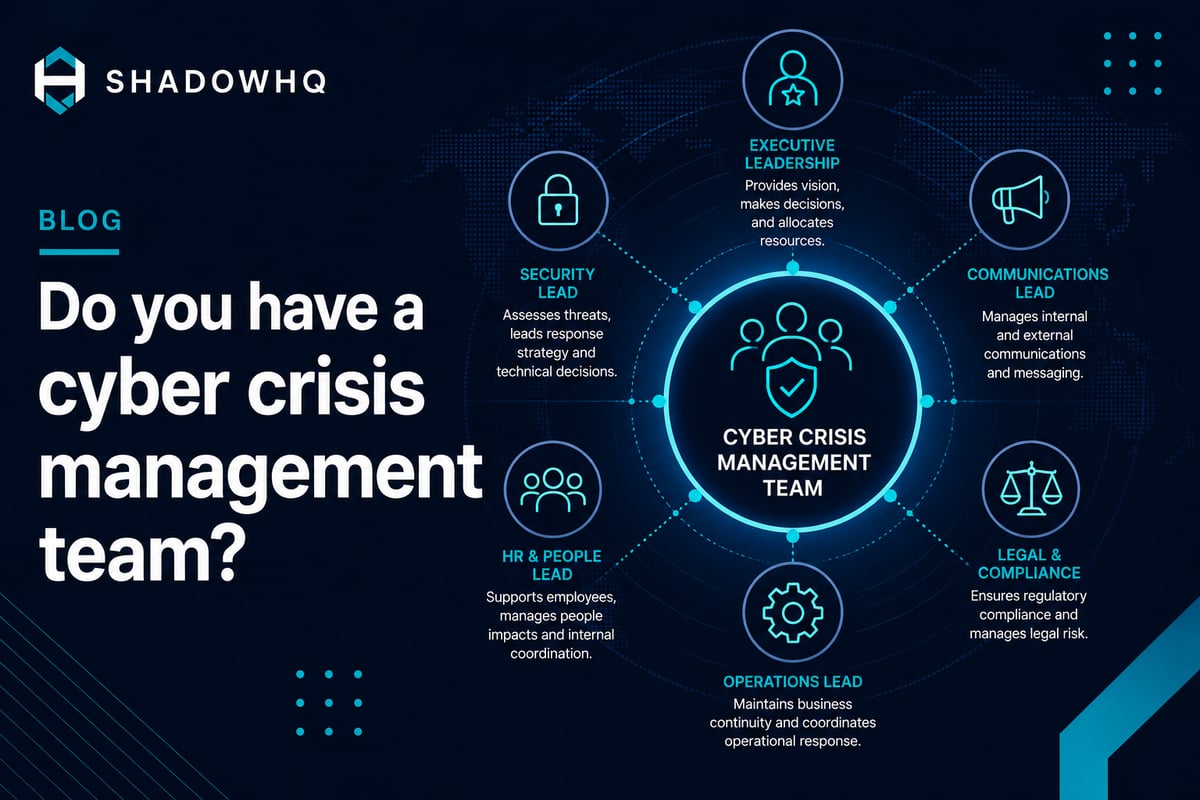

A Cyber Crisis Management Team (CCMT) is a cross-functional group responsible for coordinating an organization's overall response to a significant cyber incident.
Unlike an Incident Response Team, which focuses primarily on the technical aspects of detecting, containing, and recovering from an attack, the crisis management team oversees the broader business response.
Their responsibilities include:
- Coordinating executive decision-making
- Managing internal and external communications
- Protecting critical business operations
- Meeting legal and regulatory obligations
- Supporting employees and customers
- Prioritizing recovery activities
- Maintaining situational awareness across the organization
Think of it this way:
- The incident response team works on the cyber attack.
- The cyber crisis management team works through the business disruption the attack creates.
If you're unsure where those responsibilities overlap, our article Incident Response vs. Crisis Management: What's the Difference? explores how these two teams work together during a cyber incident.
Cyber Crisis Management vs. Crisis Management
Every organization should have a crisis management capability—but not every crisis looks the same. Traditional crisis management plans often address events like:
- Natural disasters
- Workplace violence
- Product recalls
- Executive succession
- Public relations incidents
- Pandemic response
Cyber crises introduce an entirely different set of challenges. Organizations may need to respond to:
- Ransomware attacks
- Data breaches
- Cloud service compromises
- Third-party supplier incidents
- Business email compromise
- Insider threats
- Critical infrastructure outages
Unlike many traditional crises, cyber incidents evolve rapidly and often affect both technology and business operations simultaneously. That's why many organizations establish a dedicated cyber crisis management function rather than relying solely on a general crisis management plan.
If you'd like to explore this distinction further, read our guide to Crisis Management vs. Cyber Crisis Management.
When Should a Cyber Crisis Management Team Be Activated?
Not every security incident requires activating the crisis management team. A phishing email blocked by your email gateway probably doesn't require executive involvement. A ransomware attack encrypting production systems almost certainly does.
Your organization should define clear activation criteria based on factors such as:
- Significant business disruption
- Customer-facing service outages
- Confirmed ransomware
- Sensitive data exposure
- Regulatory reporting requirements
- Executive involvement
- Financial impact
- Media attention
- Operational risk
Having clear thresholds helps organizations escalate quickly without debating whether an incident is "serious enough."
Who Should Be on a Cyber Crisis Management Team?
One of the biggest misconceptions is that cyber crisis management belongs solely to the IT or security department. In reality, effective crisis management depends on collaboration across the organization. Here are the key roles every cyber crisis management team should consider.
Incident Commander
Every effective cyber crisis management team needs someone responsible for coordinating the response. The Incident Commander isn't necessarily the most technical person in the room. They're responsible for:
- Establishing priorities
- Coordinating response activities
- Facilitating decision-making
- Maintaining situational awareness
- Keeping the entire team aligned
Think of the Incident Commander as the conductor of the orchestra—ensuring every part of the organization is working together toward the same objectives. Our guide What Is an Incident Commander in Cybersecurity? explores this role in greater detail.
Executive Sponsor
Major cyber incidents often require executive-level decisions. An executive sponsor helps:
- Approve strategic decisions
- Remove organizational roadblocks
- Coordinate with the board
- Allocate resources
- Balance business priorities
Their involvement ensures the response aligns with broader business objectives.
Security and Incident Response
These teams investigate the attack itself. Responsibilities typically include:
- Threat analysis
- Containment
- Forensics
- Eradication
- Recovery validation
Their findings inform the decisions made by the broader crisis management team.
IT Operations and Infrastructure
Infrastructure teams focus on restoring business systems safely. This may include:
- Server recovery
- Identity systems
- Cloud infrastructure
- Network services
- Backup restoration
Their work helps return critical business operations to normal.
Legal and Compliance
Cyber incidents often carry legal and regulatory obligations. Legal teams may advise on:
- Privacy regulations
- Notification requirements
- Contractual obligations
- Law enforcement engagement
- Insurance coordination
- Documentation
Early legal involvement helps organizations avoid unnecessary compliance risks.
Communications and Public Relations
Clear communication builds trust during a crisis. Communications teams coordinate messaging for:
- Employees
- Customers
- Partners
- Regulators
- Investors
- Media
Preparing messaging before an incident occurs helps organizations communicate confidently when every update matters.
Human Resources
Employees are often directly affected during cyber incidents. HR may support:
- Internal communications
- Employee guidance
- Workforce coordination
- Insider threat investigations
- Business continuity planning
Keeping employees informed reduces confusion and helps maintain productivity throughout the response.
Customer Success and Business Operations
Customers don't just care that you're responding. They want to know how the incident affects them. Customer-facing teams help:
- Respond to inquiries
- Coordinate service updates
- Manage escalations
- Maintain customer confidence
At the same time, business operations teams help prioritize the services that must remain available throughout recovery.
External Partners
Many organizations also include trusted external advisors, such as:
- Incident response firms
- Cyber insurance providers
- Outside legal counsel
- Public relations agencies
- Technology vendors
- Law enforcement, when appropriate
Knowing who to call before an incident occurs can save valuable time during the response.
How a Cyber Crisis Management Team Works During an Incident
One of the biggest differences between successful organizations and struggling ones isn't technical expertise. It's organization. Rather than everyone joining one large conference call and reacting independently, mature organizations operate through a structured command model.
The Incident Commander coordinates functional leaders.
Functional leaders coordinate their respective teams.
Regular status updates provide a shared understanding of:
- What happened
- What's currently happening
- Decisions made
- Outstanding risks
- Open tasks
- Immediate priorities
This creates a common operating picture that keeps everyone aligned, even as the situation changes.
Why Communication Is the Foundation of Every Crisis Management Team
No matter how experienced your team is, it can't function without reliable communication. During a cyber crisis, communication serves several critical purposes:
- Sharing accurate information
- Coordinating response activities
- Assigning tasks
- Escalating decisions
- Tracking progress
- Maintaining accountability
Poor communication doesn't just slow recovery. It creates confusion, duplicate work, conflicting priorities, and unnecessary delays. That's why communication planning is one of the most important parts of any cyber crisis management program.
If you're building your organization's communication strategy, our Cyber Crisis Communications Playbook provides practical guidance for preparing before an incident occurs.
Why Out-of-Band Communications Matter
Here's a question every organization should ask: What happens if the systems your crisis management team relies on become unavailable? Many cyber incidents affect the very tools organizations use every day:
- Microsoft Teams
- Slack
- Corporate email
- VPN access
- Active Directory
- Collaboration platforms
If those systems become compromised—or can't be trusted—the crisis management team still needs a secure way to communicate.
That's why more organizations are incorporating out-of-band communications into their cyber resilience strategies.
Out-of-band communication platforms operate independently from the organization's primary IT environment, allowing the crisis management team to coordinate securely even when traditional communication channels aren't available.
It's not simply a backup messaging tool. It's the foundation that allows the crisis management team to continue operating under the most challenging circumstances.
To learn more, read our guide on Out-of-Band Communication: Secure Channels During a Crisis, or explore our comparison of the Best Out-of-Band Communication Tools available today.
Common Mistakes Organizations Make
Even well-prepared organizations can struggle if roles and responsibilities aren't clearly defined. Some of the most common mistakes include:
- Assuming cybersecurity is only the IT department's responsibility
- Waiting until an incident occurs to assign roles
- Not identifying an Incident Commander
- Leaving executives out of tabletop exercises
- Relying entirely on corporate communication systems
- Failing to define decision-making authority
- Never reviewing lessons learned after exercises or real incidents
Fortunately, each of these challenges can be addressed through planning and regular practice.
Building Your Cyber Crisis Management Team
Building an effective team doesn't happen overnight, but it also doesn't need to be overly complicated. A strong starting point includes:
- Assigning primary and alternate team members
- Defining responsibilities for every role
- Establishing an Incident Commander
- Creating crisis communication procedures
- Documenting key contacts
- Developing response playbooks
- Implementing secure out-of-band communications
- Running regular tabletop exercises
- Reviewing and updating plans after every exercise and incident
Like any high-performing team, a cyber crisis management team improves through preparation and repetition—not improvisation.
Frequently Asked Questions
Who should be on a cyber crisis management team?
A cyber crisis management team typically includes executive leadership, an Incident Commander, security and incident response leaders, IT operations, legal, communications, HR, compliance, customer-facing teams, and external partners when needed.
What's the difference between an incident response team and a cyber crisis management team?
An incident response team focuses on the technical investigation and containment of cyber threats. A cyber crisis management team coordinates the broader business response, including leadership, communications, legal obligations, and operational continuity.
When should a cyber crisis management team be activated?
Organizations typically activate the team when a cyber incident causes significant business disruption, customer impact, regulatory concerns, executive involvement, or operational risk.
Do small organizations need a cyber crisis management team?
Yes. Even if one person performs multiple roles, every organization benefits from clearly defining responsibilities and decision-making before a cyber incident occurs.
How often should a cyber crisis management team train?
Most organizations should conduct tabletop exercises at least annually, with additional exercises after major organizational changes or significant cyber incidents.
How ShadowHQ Helps
A cyber crisis management team is only effective if its members can communicate, coordinate, and make decisions quickly.
ShadowHQ provides organizations with a secure, purpose-built environment for managing cyber crises through out-of-band communications, incident command workflows, playbook management, task coordination, and real-time operational visibility. Instead of relying on disconnected tools or communication systems that may be unavailable during an attack, crisis management teams can stay aligned from the initial alert through recovery.
Whether you're building your first cyber crisis management team or strengthening an existing cyber resilience program, ShadowHQ helps turn planning into coordinated action when it matters most.
.png?width=600&height=331&name=Image%20(1).png)