-1.png?width=193&height=42&name=Shadow%20HQ%20Logo%201%20(2)-1.png)

Why Traditional Incident Response Plans Fail During Real Attacks
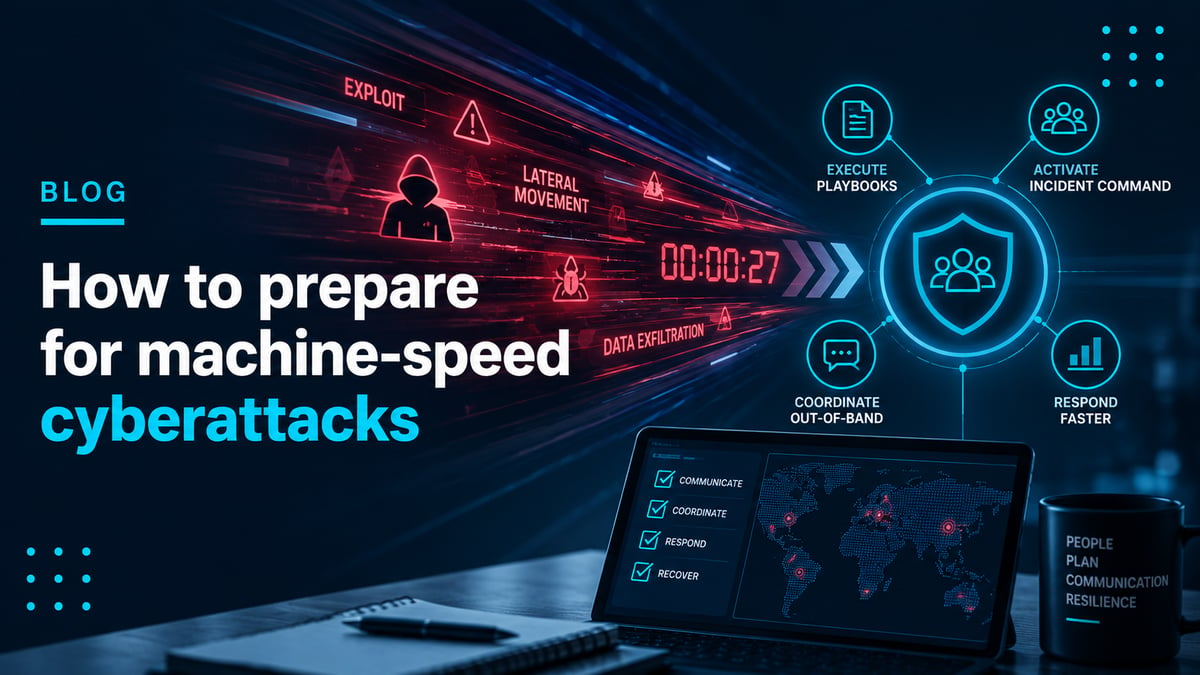
Twenty-seven seconds. That's the fastest eCrime breakout time observed in CrowdStrike's 2026 Global Threat Report.
The average wasn't much more comforting: just 29 minutes, representing a 65% increase in speed from the previous year. CrowdStrike also reported an 89% year-over-year increase in attacks by AI-enabled adversaries. Cyberattacks have always been a race against time. AI is making that race considerably faster.
Much of the cybersecurity conversation around AI has understandably focused on detection and prevention. Organizations are investing in AI-powered security tools that can identify threats, analyze enormous amounts of data and automate defensive actions faster than human analysts ever could.
But there's another part of the equation that deserves just as much attention. What happens to incident response when the attack moves faster than the organization responding to it?
How is AI changing cyber incident response?
AI is compressing the time organizations have to detect, coordinate and respond to cyberattacks. As attackers use AI and automation to accelerate reconnaissance, credential theft, lateral movement and other activities, organizations need response processes that can activate just as quickly. That means establishing incident command, predefined roles, executable playbooks and secure out-of-band communications before an attack occurs.
How AI-driven cyberattacks are shrinking the incident response window
Attackers are finding ways to use AI across the attack lifecycle. CrowdStrike's research found adversaries using AI to accelerate reconnaissance, credential theft and evasion. Threat actors are also moving across identity, SaaS, cloud and endpoint environments, often using legitimate credentials and tools that make malicious activity harder to distinguish from normal behavior.
The result is a dramatic compression of the timeline between initial compromise and meaningful impact. In one intrusion CrowdStrike observed, data exfiltration began within four minutes of initial access. Four minutes doesn't leave much room for organizational friction.
Yet many incident response processes still depend on a series of manual steps that were designed for a very different threat environment.
An alert comes in. Someone investigates. The incident gets escalated. The team determines its severity. Someone figures out who else needs to know. People start messaging colleagues. The response plan gets pulled up. A bridge is created. Executives, legal, communications and other stakeholders are brought in as the situation develops.
None of those individual actions sounds particularly unreasonable. Collectively, they can consume the most valuable minutes of an incident.
Why faster cyberattack detection isn't enough
Security teams have spent years trying to reduce mean time to detect (MTTD) and mean time to respond (MTTR). Those metrics still matter. But increasingly sophisticated detection and automation create an interesting question for security leaders: What happens after the technology detects the threat?
An organization might identify suspicious activity in seconds. Its security tools might automatically contain an endpoint or revoke credentials. But a serious cyber incident quickly becomes more than a technical problem. Someone needs to determine whether the event qualifies as a crisis. Someone needs authority to make decisions. Legal may need to assess regulatory obligations. Communications may need to prepare for internal or external inquiries. Business leaders may need to make decisions about shutting down systems or interrupting operations. Third-party responders, insurers, law enforcement or other stakeholders may need to become involved.
And all of those activities have dependencies.
If the security team can detect an attack in seconds but it takes 30 minutes to assemble the right people, establish authority and determine what happens next, the organization hasn't really achieved machine-speed response. It has achieved machine-speed detection followed by human-speed coordination.
That's the gap organizations now need to close.
Incident response has to become incident command
Traditional incident response tends to focus heavily on the technical response: identify, contain, eradicate and recover. Those activities remain essential. But during a significant cyber event, they represent only part of what's happening.
A major incident can involve cybersecurity, IT, legal, communications, executive leadership, risk, compliance, operations, HR and outside partners. Each group may have different responsibilities, information requirements and decisions to make.
Someone needs to coordinate them. That's where cyber incident command becomes critical.
Incident command establishes a clear structure for managing the response across the organization. Instead of figuring out roles, responsibilities and decision-making authority while an attacker is already moving through the environment, those questions are answered beforehand.
When an incident begins, the organization can activate a known response structure rather than inventing one. And as attack timelines compress, that difference becomes increasingly important.
How can organizations prepare for machine-speed cyberattacks?
Responding faster doesn't mean asking people to work faster during a crisis. It means eliminating as much unnecessary decision-making and coordination as possible before the crisis occurs.
That starts with four areas:
1. Clear incident command
Who is in charge? It sounds like an easy question until an actual incident occurs. The CISO may lead the technical response while legal manages regulatory considerations, communications handles external messaging and executives make business continuity decisions. Without an established command structure, multiple groups can begin making decisions simultaneously without a complete picture of the incident.
Organizations should establish an incident commander and define decision-making authority before an event occurs. The goal isn't to centralize every decision with one person. It's to make sure everyone understands who is coordinating the overall response, how information flows and where decisions get made.
2. Pre-defined roles and activation paths
A fast-moving incident isn't the time to decide whether legal should be involved. Organizations should establish response teams based on incident type and severity, with clear criteria for when different stakeholders are activated. A ransomware event may require one group. A third-party compromise, data breach, cloud outage or business email compromise may require another.
The important thing is that responders aren't starting from a blank page. When an incident meets predefined criteria, the appropriate people should be activated immediately.
3. Executable playbooks
There's a big difference between having an incident response plan and being able to execute one. A 70-page PDF sitting in SharePoint may satisfy a preparedness requirement, but it isn't particularly useful when responders need to make decisions in minutes.
Effective playbooks should translate the plan into action. What needs to happen first? Who owns each task? Which decisions need to be made? Which stakeholders need to be notified? What happens if primary systems or communications channels aren't available?
The easier the playbook is to activate and execute, the less cognitive load responders face during the incident itself.
4. A secure, out-of-band place to coordinate
There's another uncomfortable assumption hiding inside many incident response plans: that the tools used every day will still be trustworthy and available during an attack. Microsoft Teams, Slack, corporate email and other collaboration tools are incredibly useful for normal business operations.
But they're part of the environment you're trying to protect. If identity systems, email, collaboration platforms or corporate devices are compromised, responders may need to coordinate outside the affected environment. An out-of-band incident response platform gives the organization a separate place to mobilize responders, share information, execute playbooks and coordinate decisions without relying on systems that may be unavailable or untrusted. And that capability needs to be established before the incident happens.
Does AI mean cyber incident response should be fully automated?
No. AI and automation can dramatically improve detection, analysis and containment, but a major cyber incident still requires human judgment. Business leaders may need to make decisions about operations, legal teams may need to assess regulatory obligations, communications teams may need to manage stakeholders, and security teams may need to weigh competing containment and recovery priorities.
The goal isn't to automate humans out of incident response. It's to eliminate the organizational friction that prevents them from acting quickly.
There's an important distinction here. Humans aren't going to beat machines at machine speed. Nor should the goal be to automate every decision during a cyber crisis. Many incident decisions require context, judgment and business accountability.
The opportunity is to remove the friction surrounding those decisions.
Don't spend ten minutes figuring out who owns the incident.
Don't spend another ten searching for contact information.
Don't lose time determining which executives need to be involved.
Don't hunt for the current response plan.
Don't create a new chat and then spend the next several minutes getting everyone oriented.
And don't discover during the incident that the communication platform everyone planned to use can't be trusted.
Those are preventable delays.
Why tabletop exercises matter in AI-driven incident response
Tabletop exercises help organizations identify the communication, coordination and decision-making bottlenecks that could slow their response to a fast-moving cyberattack.
There is one more component organizations can't afford to overlook: practice. Having incident command structures, playbooks and out-of-band communications in place is valuable. Knowing that they actually work under pressure is better.
Tabletop exercises allow teams to test their response processes before they're facing a real adversary.
- Can the organization mobilize the right people quickly?
- Does everyone understand their role?
- Can the incident commander establish a common operating picture?
- Are escalation paths clear?
- Can teams communicate if primary systems are unavailable?
- Where does the response slow down?
Those exercises reveal the human and organizational bottlenecks that security technology can't solve. And every exercise creates an opportunity to improve the next response.
The incident response race has changed
Twenty-seven seconds is an extreme example. Not every attacker will move that quickly, and not every cyber incident will require an organization-wide response. But the direction of travel is clear. Attackers are becoming faster. AI is helping adversaries scale and accelerate parts of their operations. Meanwhile, security teams are adopting automation and AI to detect and contain threats more quickly. The organization surrounding those technologies has to evolve too.
Because when the next serious incident happens, the question won't simply be how quickly your security tools detected it. It will be how quickly your organization could mobilize, establish command, make decisions and act. As the attack timeline compresses, the coordination timeline has to compress with it.
Build a response process that's ready before the incident begins
ShadowHQ gives organizations a secure, out-of-band environment to coordinate cyber incidents across technical teams and the broader business. With incident command, executable playbooks, secure communications, notifications and tabletop exercise capabilities in one platform, teams can establish how they'll respond before they're under pressure to do it for real.
Because attackers are getting faster. Your response process needs to be ready to move when they do.
Ready to find out whether your incident response process can keep up? Let's talk about how ShadowHQ can help you prepare, practice and coordinate your response before the clock starts.
Frequently asked questions about AI and cyber incident response
How is AI changing cyber incident response?
AI is accelerating both sides of cybersecurity. Attackers can use AI and automation to perform reconnaissance, develop attacks and move through environments faster, while defenders can use AI to improve detection, analysis and containment. This compresses the time organizations have to coordinate people, make decisions and respond.
What are machine-speed cyberattacks?
Machine-speed cyberattacks use automation, AI or other technologies to accelerate activities that traditionally required more manual effort. The term describes a broader shift toward attacks that can develop and progress faster than traditional human-led response processes.
Why is incident command important during an AI-driven cyberattack?
Incident command establishes who is leading the response, which teams need to participate, how information is shared and where decisions are made. When attack timelines are compressed, having this structure established beforehand reduces delays and confusion.
What is out-of-band communication in incident response?
Out-of-band communication uses channels that are separate from an organization's primary IT environment. During a cyber incident, this allows responders to coordinate even if corporate email, Microsoft Teams, Slack, identity systems or other everyday tools are unavailable or potentially compromised.
Can AI automate cyber incident response?
AI can automate important elements of detection, investigation and containment, but major cyber incidents still require human judgment and cross-functional decision-making. Organizations need processes that allow technical teams, executives, legal, communications and other stakeholders to coordinate quickly.
How can organizations prepare for faster AI-driven cyberattacks?
Organizations can prepare by establishing clear incident command, defining roles and escalation paths, developing executable response playbooks, implementing secure out-of-band communications and regularly testing those processes through tabletop exercises.
.png?width=600&height=331&name=Image%20(1).png)