-1.png?width=193&height=42&name=Shadow%20HQ%20Logo%201%20(2)-1.png)

What Is an Incident Commander in Cybersecurity? Roles, Responsibilities, and Best Practices
Most organizations have an incident response plan.
Far fewer have a plan for managing the business disruption that follows a major cyberattack.
When ransomware encrypts critical systems, identity infrastructure is compromised, or communication platforms become unavailable, organizations quickly discover that technical response is only part of the challenge. Security teams may be investigating the attack, but executives need updates, legal teams must assess obligations, communications teams need guidance, and business leaders are making decisions that affect customers, employees, and operations.
In these moments, organizations need more than incident response.
They need cyber incident command.
What Is Cyber Incident Command?
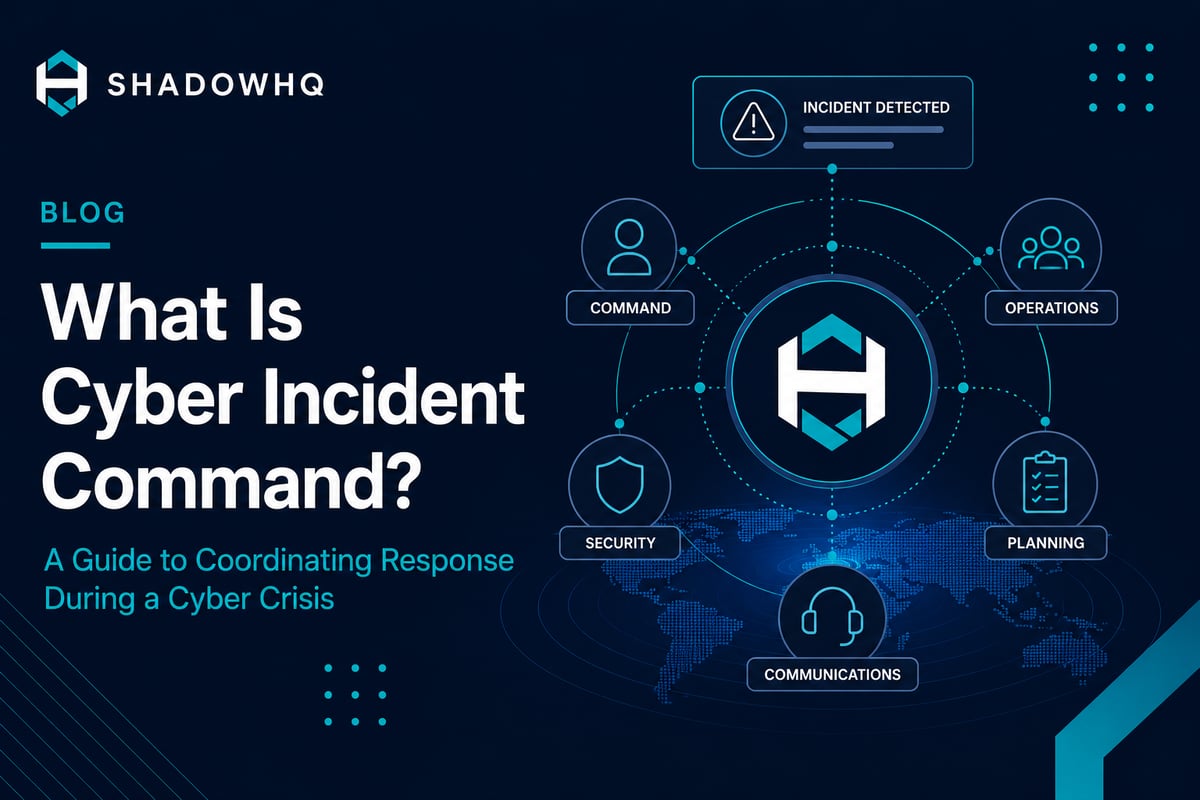
Cyber incident command is the process of coordinating people, communications, decisions, and response activities during a cybersecurity incident.
While incident response focuses on the technical investigation and containment of a threat, incident command focuses on managing the broader organizational response. It provides the structure needed to align stakeholders, coordinate actions, maintain situational awareness, and make timely decisions during a cyber crisis.
Think of incident response as the effort to stop the attack.
Think of incident command as the effort to manage the crisis.
Both are essential, but they serve different purposes.
Incident Response vs. Incident Command: What's the Difference?
The terms are often used interchangeably, but they represent distinct disciplines.
Incident response is focused on the technical aspects of an attack. Security teams investigate what happened, determine the scope of compromise, contain the threat, and begin recovery efforts.
Incident command focuses on coordinating the people, processes, and decisions required to guide the organization through the event.
|
Incident Response |
Incident Command |
|
Technical execution |
Organizational coordination |
|
Investigate and contain threats |
Manage the overall crisis |
|
Security-focused |
Business-wide |
|
Led by responders and analysts |
Led by incident leaders and stakeholders |
|
Focuses on the attack |
Focuses on business impact |
A useful way to think about the distinction is this:
Incident response fights the threat. Incident command manages the organization.
As cyber incidents become more disruptive and far-reaching, both functions are increasingly necessary.
Why Traditional Incident Response Plans Often Fail
Many incident response plans look effective on paper. The problem is that real-world attacks rarely unfold according to plan.
Modern cyberattacks frequently target the systems organizations rely on to coordinate response efforts. Email becomes unavailable. Identity systems are compromised. Collaboration tools cannot be trusted. Key personnel are difficult to reach. Critical information becomes fragmented across multiple channels.
As the technical response grows more complex, the number of stakeholders involved also increases.
A significant cyber incident may require coordination between:
- Security teams
- IT operations
- Executive leadership
- Legal counsel
- Communications and public relations
- Human resources
- Business operations
- Cyber insurance providers
- External incident response firms
Without a defined command structure, confusion often replaces coordination.
Teams duplicate work. Decisions are delayed. Critical updates are missed. Leadership lacks visibility into what is happening and what actions are being taken.
The challenge is no longer technical. It becomes operational.
How Cyber Incident Command Works
Cyber incident command establishes a structured framework for managing complex incidents and ensuring stakeholders remain aligned throughout the response.
While every organization will implement it differently, most incident command models include five key components.
1. Establish Incident Leadership
Every major incident requires clear ownership.
An Incident Commander is appointed to direct the overall response effort, coordinate stakeholders, facilitate decision-making, and maintain accountability across the organization.
This role is not necessarily the most senior executive or the most experienced technical responder.
Instead, the Incident Commander serves as the central coordinator responsible for ensuring the response remains organized and effective.
2. Activate Stakeholders
As an incident develops, relevant stakeholders must be engaged quickly and consistently.
This often includes representatives from security, IT, legal, communications, operations, and executive leadership.
Rather than relying on ad hoc communication, incident command provides a structured process for activating the right people at the right time.
3. Coordinate Communications
One of the most critical responsibilities during a cyber crisis is maintaining clear communication.
Stakeholders need accurate information about:
- What happened
- Current response efforts
- Business impacts
- Immediate risks
- Next steps
Incident command helps create a single source of truth that prevents conflicting information and reduces confusion across teams.
4. Manage Tasks and Accountability
Cyber incidents generate dozens—or even hundreds—of actions that must be completed under pressure.
Examples include:
- Engaging forensic investigators
- Coordinating with cyber insurers
- Meeting regulatory notification requirements
- Communicating with customers
- Recovering critical systems
Incident command ensures responsibilities are assigned, tracked, and completed in a coordinated manner.
5. Maintain Situational Awareness
Effective decision-making depends on visibility.
Incident leaders need a clear understanding of:
- Current incident status
- Open tasks
- Escalations
- Risks
- Recovery progress
- Business impacts
Maintaining this operational picture allows leadership teams to make informed decisions as conditions evolve.
What Is an Incident Commander?
An Incident Commander is the individual responsible for directing and coordinating the overall response to a cyber incident.
Their role is not to perform technical investigations or remediation activities. Instead, they ensure that all response efforts remain aligned with organizational priorities and business objectives.
Typical responsibilities include:
- Leading incident meetings
- Coordinating stakeholders
- Prioritizing response activities
- Escalating critical decisions
- Managing communications
- Monitoring overall progress
- Maintaining accountability across teams
The most effective Incident Commanders combine leadership, communication, and decision-making skills with a strong understanding of incident management processes.
What Are the Benefits of Cyber Incident Command?
Organizations that adopt formal incident command practices often experience significant improvements in response effectiveness.
Faster Decision-Making — Clearly defined roles and responsibilities reduce delays and accelerate critical decisions.
Improved Coordination — Teams remain aligned on priorities, responsibilities, and objectives throughout the incident.
Better Communication — Stakeholders receive consistent updates and accurate information.
Reduced Business Disruption — More efficient coordination helps organizations recover faster and minimize operational impact.
Greater Executive Visibility — Leadership teams gain real-time insight into response activities, risks, and recovery efforts.
Ultimately, incident command helps organizations move from reactive chaos to coordinated action.
Why Out-of-Band Communication Is Becoming Essential
One of the biggest challenges facing modern incident responders is that the systems used to coordinate response are increasingly becoming targets themselves.
Attackers understand that disrupting communication can significantly slow an organization's ability to respond.
Today, many attacks involve:
- Identity compromise
- Email outages
- Collaboration platform disruptions
- Network isolation
- Credential theft
When primary communication channels are unavailable or untrusted, coordination becomes significantly more difficult.
This is why many organizations are adopting out-of-band incident command capabilities that operate independently from their primary IT environment.
These platforms provide secure communication, stakeholder coordination, task management, and situational awareness even when core systems are unavailable.
For many organizations, out-of-band incident command is becoming a critical component of cyber resilience.
Frequently Asked Questions
Is cyber incident command the same as incident response?
No. Incident response focuses on technical investigation and remediation. Incident command focuses on coordinating people, decisions, communications, and business activities during a cyber crisis.
Who should lead cyber incident command?
A designated Incident Commander should lead the effort, supported by executive leadership and cross-functional stakeholders.
What is an incident command center?
An incident command center is the physical or virtual location where incident leaders coordinate response activities, communications, and decision-making.
When should incident command be activated?
Incident command should be activated whenever a cyber incident has the potential to significantly impact business operations, customers, regulatory obligations, or organizational reputation.
What tools support cyber incident command?
Organizations commonly use incident command platforms, crisis management tools, out-of-band communication systems, task management solutions, and collaboration platforms designed for cyber response.
How ShadowHQ Helps Organizations Establish Cyber Incident Command
Establishing an effective cyber incident command capability requires more than documented procedures. Organizations need a secure, reliable way to coordinate people, communications, decisions, and response activities when their primary systems may be unavailable or compromised.
ShadowHQ is an out-of-band cyber incident command platform designed to help organizations prepare for, manage, and recover from cyber incidents with greater confidence and control.
Unlike traditional collaboration tools that rely on the same infrastructure attackers often target, ShadowHQ operates independently from an organization's production environment, providing a dedicated platform for incident coordination before, during, and after a cyber event.
With ShadowHQ, organizations can:
Coordinate Stakeholders Across the Business — Bring together security teams, IT operations, executives, legal counsel, communications, HR, and external partners within a centralized incident command environment.
Activate and Communicate Quickly — Use out-of-band notifications, voice, SMS, email, and mobile communications to reach stakeholders rapidly, even when primary communication channels are unavailable.
Operationalize Incident Command — Move beyond static incident response plans with role-based workflows, predefined playbooks, escalation paths, and response procedures that guide teams through high-pressure situations.
Maintain Situational Awareness — Provide incident leaders with a real-time operational view of response activities, open tasks, stakeholder engagement, and recovery progress to support faster decision-making.
Strengthen Preparedness Before an Incident Occurs — Conduct tabletop exercises, test response plans, validate communication workflows, and continuously improve incident command processes before a crisis happens.
Support the Full Incident Lifecycle — From preparedness and activation through response, recovery, and post-incident review, ShadowHQ helps organizations build a repeatable and resilient approach to cyber incident command.
As cyber incidents continue to evolve into business-wide crises, organizations need more than technical response capabilities. They need a structured, operational framework for leading the response, aligning stakeholders, and maintaining control when every minute matters.
That's the role of cyber incident command—and the problem ShadowHQ was built to solve.
The Future of Cyber Response Is Incident Command
Cyber incidents are no longer isolated technical events.
They are business crises that affect operations, reputation, customers, regulators, and leadership teams simultaneously.
As attacks continue to evolve, organizations are recognizing that technical response alone is not enough. Success increasingly depends on the ability to coordinate stakeholders, communicate effectively, maintain situational awareness, and make timely decisions under pressure.
That is the role of cyber incident command.
Because when a major cyber crisis occurs, the ability to coordinate the response may be just as important as the ability to contain the threat.
ShadowHQ can help. Book a personalized demo today to see how the ShadowHQ platform can help your team establish and operationalize incident command best practices.
.png?width=600&height=331&name=Image%20(1).png)