-1.png?width=193&height=42&name=Shadow%20HQ%20Logo%201%20(2)-1.png)

Who Should Lead a Cyber Incident? Why Every Organization Needs an Incident Commander
A cyber incident might begin with an alert in the SOC, but it rarely stays there.
As the situation develops, more people get involved. IT may be isolating systems. Legal is assessing potential exposure. Communications is preparing for questions. Executives want to understand business impact. Risk and compliance teams are considering reporting obligations. External counsel, insurers and incident response partners may need to join the conversation.
Before long, the organization isn't just responding to a technical incident. It's managing a business crisis. That's when coordination becomes critical.
Effective cyber incident response requires a structure that gives technical and business teams a shared understanding of what's happening, what matters most, who owns each action and what needs to happen next. So how do you coordinate a cyber incident across the business?
What Is Cross-Functional Cyber Incident Response?
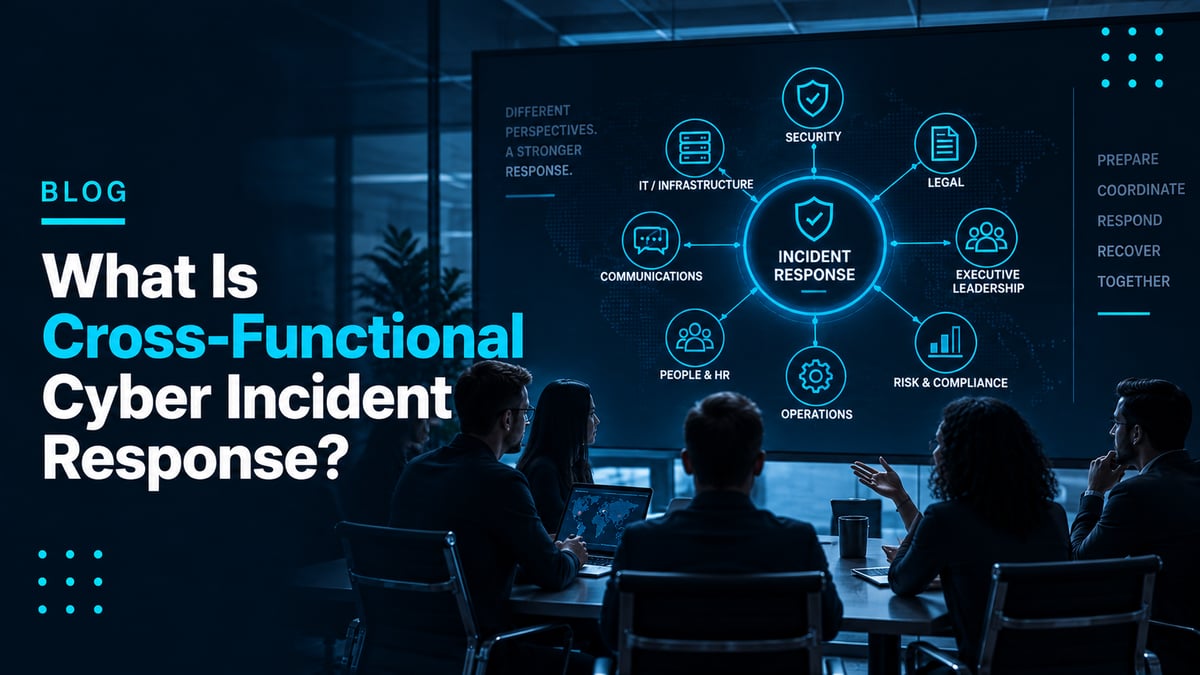
Cross-functional cyber incident response is the coordinated involvement of technical, legal, operational, communications, executive and external stakeholders in managing a cybersecurity incident.
Security and IT teams typically lead technical investigation, containment and remediation. But as an incident affects customers, employees, operations, reputation, regulatory obligations or business continuity, decisions extend well beyond the security function.
Cross-functional response brings those teams into a shared response structure. Depending on the incident, that may include:
- Security / SOC
- IT
- Executive leadership
- Legal
- Privacy
- Risk and compliance
- Communications / PR
- Business continuity
- Human resources
- Finance
- Cyber insurance
- External counsel
- Incident response providers
- Other affected business units or third parties
The objective isn't to involve everyone in every decision. It's to make sure the right people have the right information and decision-making authority at the right time.
Why Cyber Incident Response Extends Beyond the Security Team
Security teams are responsible for many of the most urgent activities during an attack.
- What happened?
- Which systems are affected?
- Is the attacker still present?
- How can the organization contain the incident?
- What needs to be restored?
Those questions are essential, but they're only part of the response. Consider a ransomware incident. While security investigates and IT works on containment and recovery, other questions may emerge:
- Legal: Has sensitive information been accessed or stolen? What legal obligations could apply?
- Privacy and compliance: Does the incident trigger regulatory notification requirements?
- Executives: What is the operational and financial impact? Which business services should be prioritized?
- Communications: What do we tell employees, customers, partners or the media?
- Business continuity: How do critical functions continue operating while systems are unavailable?
- Cyber insurance: When does the carrier need to be notified? Are specific providers or procedures required?
- External counsel and incident response partners: When should they be engaged, and what information do they need?
All of those activities may happen simultaneously. This is why a cyber incident can quickly become a coordination problem as much as a technical one.
Incident Response vs. Incident Command: What's the Difference?
This distinction is important.
Incident response focuses on the activities required to investigate, contain, remediate and recover from a cybersecurity incident.
Incident command provides the structure for coordinating the people, decisions, communications and response activities surrounding that incident.
Another way to think about it: technical teams respond to the attack. Incident command coordinates the organization responding to the crisis. The two functions are closely connected, but they aren't interchangeable. A technically excellent response can still be slowed down by unclear decision-making, fragmented communications, missing stakeholders or conflicting priorities.
Incident command helps keep those pieces aligned.
Who Should Coordinate a Cyber Incident?
Organizations should establish an incident commander or equivalent leadership role before a serious incident occurs. The incident commander doesn't need to be the person with the deepest technical expertise. Their responsibility is to maintain the broader view of the response. That can include:
- Establishing response priorities
- Coordinating teams and workstreams
- Maintaining situational awareness
- Identifying outstanding decisions
- Tracking owners and dependencies
- Escalating issues
- Keeping stakeholders informed
- Adjusting priorities as the incident changes
Technical leaders can then remain focused on investigation, containment and recovery without also carrying the entire burden of organizational coordination. The incident commander should also have clearly defined authority. Teams need to understand what decisions that person can make, which decisions require executive approval and how disagreements or competing priorities will be resolved.
That structure is difficult to invent while an attack is already underway.
How Do You Coordinate a Cyber Incident Across the Business?
Strong cross-functional coordination starts before an incident occurs. Here are seven areas organizations should establish and practice.
1. Define the Incident Command Structure — Start by answering some basic questions. Who assumes command during a major cyber incident? Who acts as backup? What authority does the incident commander have? Which teams report into the command structure? How are major decisions escalated? Different organizations may use different models, but the important thing is having a structure people understand. When an incident occurs, there shouldn't be a prolonged debate about who's in charge.
2. Identify Cross-Functional Stakeholders in Advance — Don't wait for an incident to determine who needs to participate. Map stakeholders to likely incident scenarios. A ransomware incident may require one group. A privacy breach may require another. An insider threat could bring HR into the response much earlier. Your incident response playbooks should define these roles in advance so teams can be activated quickly.
Also identify external stakeholders such as:
- Outside counsel
- Cyber insurers
- Incident response firms
- Forensics providers
- Communications agencies
- Critical vendors
Make sure contact information is current and responders know how those parties will be brought into the response.
3. Establish a Shared Operating Picture — One of the hardest parts of managing a cyber crisis is maintaining a common understanding of what's happening. Different teams naturally see the incident through different lenses. Security sees indicators of compromise. IT sees system availability. Legal sees potential exposure. Executives see operational impact. Communications sees stakeholder concerns. Incident command needs to bring those perspectives together into a shared operating picture.
At any point, responders should be able to understand:
- What do we know?
- What don't we know?
- Which systems or business functions are affected?
- What are the current priorities?
- What actions are underway?
- Who owns them?
- What decisions are outstanding?
- What has changed?
Without that shared view, teams can easily begin working from different versions of the incident.
4. Give Every Action and Decision an Owner — Cyber incidents generate tasks quickly. Investigate an endpoint. Engage counsel. Contact the insurer. Prepare employee communications. Review regulatory requirements. Restore a critical application. Brief the board. Someone needs to own each action. A strong incident command process makes ownership visible and tracks dependencies between tasks. This is one reason [executable incident response playbooks] can be more useful than static response documents. They allow teams to move from reading what should happen to actively managing who's doing it and what comes next.
5. Establish a Communication Cadence — Not everyone needs every update. An effective response establishes a predictable rhythm for communicating information. That might include:
- Continuous communication among active responders
- Scheduled situation reports
- Executive briefings
- Legal or regulatory updates
- Employee communications
- Customer or partner notifications
Define who receives each type of update and who is responsible for providing it. A regular cadence also reduces one of the biggest distractions during a crisis: stakeholders repeatedly asking the response team for updates.
6. Be Ready to Communicate Out-of-Band — Cross-functional coordination depends on communication. But during a cyberattack, the organization's normal communication tools may be unavailable, compromised or untrusted. Email, Microsoft Teams, Slack, SSO and other corporate systems can all become part of the affected environment. Organizations should therefore establish out-of-band communications before an incident occurs.
An out-of-band environment allows responders to move communications away from potentially compromised infrastructure while keeping technical teams, business stakeholders and external partners connected. This needs to be part of the response plan, not an improvised workaround.
7. Document Decisions as the Incident Unfolds — Cyber incidents can move quickly, and the rationale behind a decision can be difficult to reconstruct later. Maintain a record of:
- Actions taken
- Decisions made
- Decision owners
- Information available at the time
- Approvals
- Communications
- Important changes in the incident
- Outstanding issues
That record supports legal and regulatory needs, after-action reviews, cyber insurance requirements and future improvements to the response process. It also gives the organization a reliable timeline rather than forcing teams to reconstruct events from emails, chats, spreadsheets and individual recollections.
How Do You Keep Technical and Business Teams Aligned During an Incident?
One of the biggest challenges in cross-functional response is that different teams speak different languages. A security team might report: "We've identified lateral movement from a compromised privileged account and isolated the affected subnet."
An executive needs to know: "Can we operate? Are customers affected? How long might recovery take?"
Legal may ask: "Do we know whether information was accessed or exfiltrated?"
Communications wants to know: "What can we confidently say right now?"
All of these are legitimate questions. Incident command creates a bridge between the technical details of the attack and the decisions the business needs to make. That doesn't mean oversimplifying technical information. It means translating it into business impact, risk, decisions and actions that other stakeholders can use.
A useful incident update should make clear:
What happened → What is affected → What are we doing → What decisions are needed → What happens next.
How Should Executives Be Involved in Cyber Incident Response?
Executives need enough information to make business decisions without becoming another layer of operational complexity. Their role may include:
- Setting business priorities
- Approving major operational decisions
- Assessing financial impact
- Managing board-level communication
- Approving external communications
- Supporting regulatory or legal decisions
- Resolving conflicts between business priorities
Executives don't need to participate in every technical discussion. Instead, incident command should provide concise, decision-oriented updates. For example:
Current situation: What has happened?
Business impact: What is affected?
Response status: What are teams doing?
Risk: What could happen next?
Decision required: What do we need from leadership?
That structure makes executive involvement considerably more useful than simply adding senior leaders to every incident call.
What Is the Role of Legal During a Cyber Incident?
Legal teams can become involved early in significant cyber incidents, particularly when sensitive information, regulatory requirements, contractual obligations or potential litigation are involved.
Depending on the event, legal may help the organization:
- Engage external counsel
- Assess notification obligations
- Coordinate with cyber insurers
- Evaluate contractual requirements
- Preserve privilege where appropriate
- Review external communications
- Support regulatory engagement
- Document significant decisions
Legal should therefore be included in relevant [incident response playbooks] and tabletop exercises rather than treated as someone to call once the technical work is finished.
Practice Cross-Functional Coordination Before an Incident
Knowing who's on the incident response team isn't the same as knowing how those people will work together. That's why tabletop exercises are so important.A good tabletop allows technical and business teams to practice:
- Activating incident command
- Escalating an incident
- Assigning responsibilities
- Sharing information
- Making difficult decisions
- Communicating out-of-band
- Working with external partners
- Briefing executives
- Responding as the scenario changes
It also exposes assumptions. Maybe legal thought security would notify the insurer.
Security thought risk owned it. Risk thought the incident commander was handling it. That's exactly the kind of discovery you want to make during an exercise rather than a real event.
How ShadowHQ Helps Coordinate Cyber Incidents Across the Business
ShadowHQ provides an out-of-band cyber incident command environment where technical and business responders can coordinate a crisis without relying on potentially compromised corporate systems.
Instead of managing the response across disconnected emails, chats, spreadsheets, documents and conference calls, organizations can bring responders into a shared environment designed for incident command.
ShadowHQ helps teams:
- Activate predefined incident response playbooks
- Establish roles and task ownership
- Coordinate technical and business workstreams
- Create secure war rooms and breakout rooms
- Communicate out-of-band
- Notify internal and external stakeholders
- Track actions, decisions and dependencies
- Maintain a shared incident timeline
- Practice cross-functional response through tabletop exercises
- Capture lessons learned for future incidents
This allows technical responders to focus on addressing the attack while incident command maintains visibility across the broader organizational response.
Frequently Asked Questions About Cross-Functional Cyber Incident Response
Who should be involved in cyber incident response?
Cyber incident response may involve security, IT, legal, privacy, risk and compliance, communications, business continuity and executive leadership, along with external counsel, cyber insurers and incident response providers. The exact team should reflect the nature and severity of the incident.
Who should coordinate a cyber incident?
Organizations should designate an incident commander or equivalent role to coordinate significant cyber incidents. The incident commander maintains situational awareness, establishes priorities, tracks decisions and dependencies, and keeps technical and business response teams aligned.
What is the difference between incident response and incident command?
Incident response focuses on investigating, containing, remediating and recovering from a cybersecurity incident. Incident command provides the structure for coordinating the people, communications, decisions and activities involved in the broader organizational response.
How do you keep teams coordinated during a cyber incident?
Organizations should establish an incident command structure, define roles in advance, activate scenario-specific playbooks, maintain a shared operating picture, assign actions and decisions to clear owners, establish communication cadences and maintain secure out-of-band communications.
Why are out-of-band communications important for cross-functional response?
Normal corporate communication systems may be unavailable or compromised during a cyberattack. Out-of-band communications give internal and external responders an independent environment where they can continue coordinating the response securely.
What information should executives receive during a cyber incident?
Executive updates should focus on the current situation, business impact, response status, major risks and decisions requiring leadership input. Executives generally don't need every technical detail; they need the information required to make timely business decisions.
Cyber Incident Response Is a Team Sport
A cyberattack may begin as a security problem. What happens next can affect operations, customers, employees, regulatory obligations, reputation and the organization's ability to do business.
Managing that kind of event requires more than excellent technical response. It requires coordination. Organizations that define their incident command structure, establish roles and decision authority, prepare executable playbooks, create out-of-band communication channels and practice together are better positioned to respond as one team when an incident occurs.
Because when the pressure is on, the goal isn't simply to have everyone involved. It's to have everyone moving in the same direction.
See how ShadowHQ helps technical and business teams coordinate cyber incident response from one secure command environment.
.png?width=600&height=331&name=Image%20(1).png)