-1.png?width=193&height=42&name=Shadow%20HQ%20Logo%201%20(2)-1.png)

Not All Out of Band Communications are created Equal: What you need to know
Most organizations already have plenty of ways to communicate. Email. Microsoft Teams. Slack. Video conferencing. Text messages. Phone calls. During normal business operations, that's more than enough.
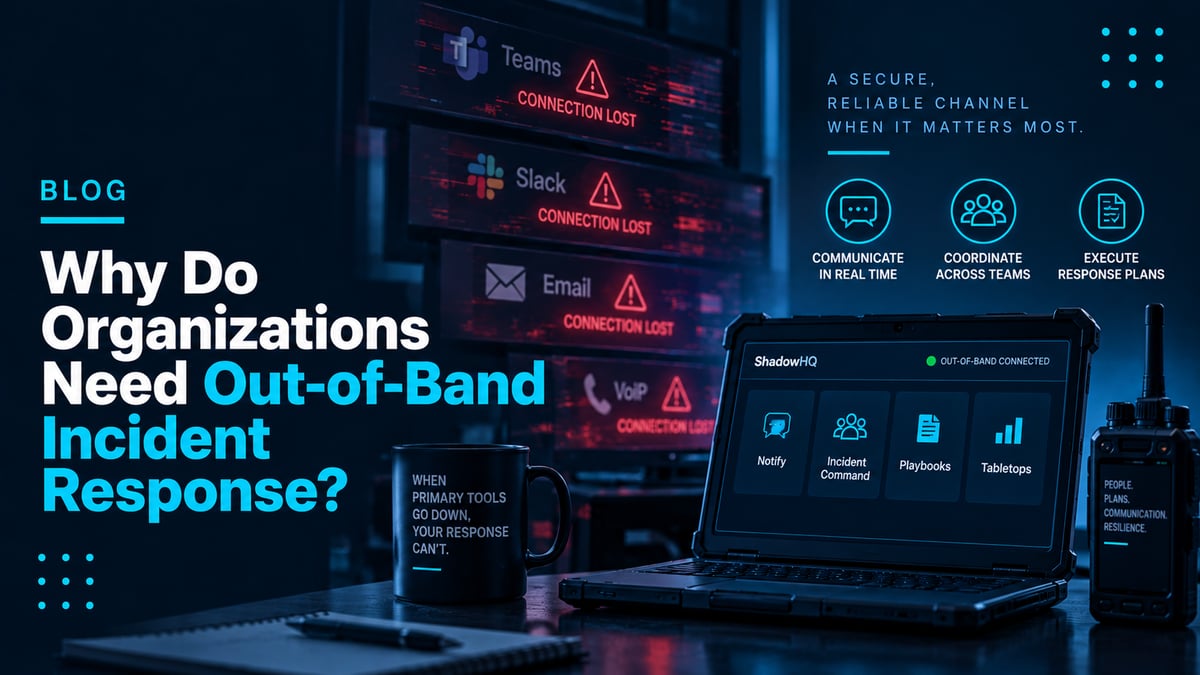
A cyber incident changes the equation. If attackers have compromised identities, gained access to corporate systems or disrupted critical infrastructure, response teams may no longer know which everyday tools they can trust. At the same time, they need to mobilize quickly, bring technical and business stakeholders together, execute response plans and make decisions under pressure.
That's why organizations are increasingly thinking beyond backup communications and toward out-of-band incident response platforms. So what exactly is an out-of-band incident response platform? How is it different from simply moving the team to another messaging app? And what capabilities should organizations look for?
What Is an Out-of-Band Incident Response Platform?
An out-of-band incident response platform is a secure environment that operates independently from an organization's primary corporate systems and enables teams to communicate, coordinate and manage response activities during a cyber incident.
Unlike everyday collaboration tools, an out-of-band incident response platform is designed specifically for crisis conditions. It gives responders an alternative environment they can use when corporate email, messaging platforms, identity systems or other infrastructure may be compromised or unavailable.
A purpose-built platform can go beyond secure communication to support activities such as:
- Activating incident response teams
- Sending emergency notifications
- Establishing incident command
- Launching incident response playbooks
- Assigning and tracking tasks
- Creating secure war rooms
- Coordinating technical and business responders
- Bringing external partners into the response
- Tracking decisions and incident timelines
- Conducting after-action reviews
The distinction matters. Out-of-band communication gives responders a safe place to talk. An out-of-band incident response platform gives them a safe place to manage the response.
Why Do Organizations Need Out-of-Band Incident Response?
Many incident response plans assume the organization's normal technology environment will remain available during a crisis. That assumption doesn't always survive contact with a real attack. Consider what can happen during ransomware, identity compromise or another serious cyber incident.
Microsoft 365 accounts may be compromised.
Single sign-on may need to be disabled.
Corporate email may be under investigation.
Endpoints may be isolated from the network.
VPN access may be unavailable.
Internal collaboration platforms may contain attacker activity or sensitive information.
Even if a tool appears to be functioning, security teams may not yet know whether it can be trusted. At exactly that moment, the organization needs to coordinate one of its most important and sensitive business processes: responding to the attack.
That's the purpose of out-of-band communications in cybersecurity: creating an independent channel responders can trust when the primary environment can't be relied upon.
An out-of-band incident response platform extends that principle to the broader response operation.
Is Microsoft Teams or Slack an Out-of-Band Communication Tool?
Not when those platforms are part of the organization's normal corporate environment.
Microsoft Teams, Slack and corporate email are excellent collaboration tools for everyday business. But if responders authenticate using the same identities, devices, networks or infrastructure affected by the incident, those tools aren't truly independent from the compromised environment.
During some incidents, organizations may intentionally restrict access to normal communication systems until security teams understand the attacker's level of access.
The question isn't whether Teams or Slack is secure under normal circumstances. The question is: Is this communication environment independent from the systems currently under investigation?
If the answer is no, the organization needs another option.
What About Signal, WhatsApp or Personal Text Messages?
Consumer messaging applications may appear to solve the immediate problem: get responders onto a different channel. But emergency messaging and coordinated incident response aren't the same thing.
Moving a response team to a group chat can create other challenges:
- Who has access?
- How are responders authenticated?
- How are external partners added or removed?
- Where are tasks tracked?
- How are decisions documented?
- How are different workstreams separated?
- Where is the incident timeline maintained?
- How are playbooks activated?
- How are records retained for an after-action review?
- How does the organization establish a single source of truth?
A messaging app can help people communicate. It doesn't necessarily help an organization command the incident. That's why an out-of-band incident response platform should be evaluated as more than a backup chat tool.
Out-of-Band Communications vs. an Out-of-Band Incident Response Platform
The terms are related, but they describe different levels of capability.
|
|
Out-of-Band Communications |
Out-of-Band Incident Response Platform |
|
Primary purpose |
Maintain trusted communications |
Coordinate and manage the response |
|
Independent environment |
Yes |
Yes |
|
Messaging / notifications |
Yes |
Yes |
|
Incident command |
Limited |
Yes |
|
Response playbooks |
Typically no |
Yes |
|
Task ownership |
Limited |
Yes |
|
War rooms / workstreams |
Sometimes |
Yes |
|
Decision tracking |
Limited |
Yes |
|
Incident timeline |
Limited |
Yes |
|
Cross-functional response |
Limited |
Yes |
|
After-action review |
Limited |
Yes |
For some organizations, backup communications may address an immediate need.
For organizations managing complex cyber incidents across security, IT, legal, executives, communications and external partners, however, the requirement is often broader.
They don't just need to keep talking. They need to keep operating.
What Should an Out-of-Band Incident Response Platform Include?
Not every platform approaches incident response in the same way. Organizations evaluating an out-of-band solution should consider several core capabilities.
1. Independence From the Corporate Environment
This is the foundation. The platform should provide an environment that remains accessible without depending entirely on potentially compromised corporate infrastructure. The goal is to avoid creating a backup communication plan that relies on the same systems and assumptions as the primary one.
Organizations should understand how users authenticate, how the platform is accessed and which dependencies could affect availability during an incident.
2. Rapid Responder Activation
Cyber incidents don't wait for everyone to check their inbox. Organizations need a reliable way to mobilize responders quickly. An incident response platform should support predefined teams, contact groups and notification procedures so the organization can activate the appropriate people without manually assembling the response team during the crisis.
Multi-channel notifications can also help reach people who aren't actively monitoring a particular application.
3. Secure War Rooms
A major cyber incident may involve dozens of responders working on different aspects of the crisis. A central command environment helps everyone maintain a shared understanding of the incident, while breakout rooms or separate workspaces allow teams to focus on specific workstreams.
For example:
Security / forensics may investigate attacker activity.
IT / recovery may focus on restoring systems.
Legal may assess regulatory and contractual obligations.
Communications may prepare internal or external messaging.
Executives may need a higher-level view of business impact and decisions.
Those teams need space to work without becoming disconnected from the overall response.
4. Incident Response Playbooks
A purpose-built platform should help organizations move from documented procedures to active response workflows.
Incident response playbooks can define:
- Activation criteria
- Roles
- Tasks
- Owners
- Dependencies
- Decision points
- Communications
- Escalation procedures
When a crisis occurs, responders should be able to activate the appropriate playbook rather than searching for a static document and figuring out how to put it into action.
5. Incident Command
Complex incidents need coordination. An out-of-band incident response platform should support a clear cyber incident command structure so the incident commander can understand:
- Current response status
- Priorities
- Task ownership
- Outstanding decisions
- Dependencies
- Escalations
- Changes in the incident
This allows technical teams to focus on addressing the attack while incident command coordinates the broader organizational response.
6. Cross-Functional Coordination
Cyber incidents rarely remain security-only events. A platform should make it possible to bring legal, risk, compliance, communications, executives, business continuity and other business stakeholders into the response when required.
It should also support external participants such as:
- Outside counsel
- Cyber insurers
- Incident response providers
- Forensics firms
- Communications agencies
- Critical vendors
The objective is to create a shared response environment without forcing every stakeholder into technical security tools.
7. Task and Decision Tracking
During a crisis, the question isn't simply, "What does the plan say?" It's: What's happening right now? Organizations should be able to see:
- Which tasks are complete
- What's in progress
- What's overdue
- Who owns each action
- Which decisions are outstanding
- Which dependencies are blocking progress
This creates accountability while giving incident commanders a clearer view of the response.
8. Incident Timeline and Audit Trail
Important actions and decisions should be documented as the incident unfolds. A reliable record can support:
- After-action reviews
- Legal analysis
- Regulatory reporting
- Cyber insurance
- Internal investigations
- Executive and board reporting
- Future exercises
It also avoids the painful process of reconstructing an incident afterward from scattered emails, chats, spreadsheets and personal notes.
9. Mobile Access
Incidents don't necessarily happen while everyone is sitting at a corporate laptop. Responders may need secure access from home, while traveling or when normal endpoints are unavailable. Mobile access can be an important part of maintaining response continuity.
10. Tabletop Exercise Capabilities
The first time responders use their crisis environment shouldn't be during a real attack.
A platform that supports cybersecurity tabletop exercises allows teams to practice with the same roles, playbooks, communications and command structure they would use during an actual incident. That helps turn the platform itself into part of the organization's preparedness program.
When Should an Organization Activate Its Out-of-Band Platform?
Organizations should define activation criteria before an incident occurs. The out-of-band environment may be activated when:
- Ransomware is detected
- Identity infrastructure is compromised
- A privileged account is breached
- Corporate communications are unavailable
- Responders aren't confident normal channels can be trusted
- A significant third-party incident occurs
- A cyber incident reaches a predefined severity level
- The organization initiates its cyber crisis management process
Importantly, teams don't always need proof that corporate communications are compromised before moving out-of-band. If the organization has reasonable uncertainty about whether normal systems can be trusted, shifting the response to an independent environment can reduce risk while the investigation continues.
The decision should follow predefined criteria rather than being improvised in the middle of the crisis.
Who Should Have Access to an Out-of-Band Incident Response Platform?
Access should reflect the organization's incident response structure. Core users may include:
- Incident commanders
- Security / SOC
- IT
- Legal
- Risk and compliance
- Privacy
- Communications
- Business continuity
- Executive leadership
Organizations should also determine how critical external responders will gain access when needed. That could include outside counsel, insurers, forensic investigators, incident response firms and other third parties. Access procedures should be established and tested before an incident. Nobody wants to spend the first hour of a ransomware response trying to remember a lawyer's personal cell number.
How Do You Evaluate an Out-of-Band Incident Response Platform?
Organizations should evaluate solutions based on how they would perform during a real incident rather than simply comparing feature lists. Useful questions include:
- Is the platform truly independent from our primary corporate environment?
- How quickly can we activate responders?
- Can we reach people across multiple communication channels?
- Can we bring external stakeholders into the response securely?
- Can we activate and manage incident response playbooks?
- Can an incident commander see tasks, owners, decisions and dependencies?
- Can separate teams work in parallel without losing the shared view of the incident?
- Does the platform maintain an incident timeline and audit trail?
- Can we practice using the platform during tabletop exercises?
- Will responders actually know how to use it under pressure?
That final question is easy to underestimate. An incident response platform isn't useful simply because an organization owns it. It needs to be incorporated into playbooks, exercised regularly and familiar to the people expected to use it.
Out-of-Band Incident Response Is Part of Cyber Preparedness
Buying an out-of-band platform doesn't automatically make an organization prepared. The technology needs to fit within a broader response program.
That means organizations should:
Define when the out-of-band environment will be activated.
Identify who needs access.
Build incident response playbooks around it.
Establish an incident command structure.
Practice through tabletop exercises.
Learn from exercises and real incidents.
Improve the process over time.
This is the same preparedness cycle that applies to incident response more broadly. The goal is to make the out-of-band environment a familiar part of the response process rather than an emergency tool nobody has touched since implementation.
How ShadowHQ Provides Out-of-Band Cyber Incident Command
ShadowHQ is an out-of-band cyber incident command platform designed to help organizations securely coordinate response when normal business systems may be compromised or unavailable.
ShadowHQ brings communications and incident management together in an independent environment where organizations can:
- Mobilize responders through multi-channel notifications
- Communicate securely out-of-band
- Create war rooms and breakout rooms
- Activate executable incident response playbooks
- Assign and track tasks
- Establish incident command
- Coordinate technical and business teams
- Bring external partners into the response
- Maintain an incident timeline
- Document actions and decisions
- Conduct tabletop exercises
- Apply lessons learned to future responses
Rather than moving responders from one chat application to another, ShadowHQ gives the organization a shared command environment for managing the incident from activation through recovery.
Frequently Asked Questions About Out-of-Band Incident Response Platforms
What is an out-of-band incident response platform?
An out-of-band incident response platform is a secure environment that operates independently from an organization's primary corporate systems and allows teams to communicate, coordinate and manage response activities during a cyber incident.
Why do organizations need out-of-band incident response?
Cyberattacks can compromise or disrupt corporate email, collaboration platforms, identity systems and networks. An out-of-band environment gives responders an independent place to coordinate the incident when normal systems can't be trusted.
Is Microsoft Teams an out-of-band communication platform?
Microsoft Teams is generally not considered out-of-band when it is part of the organization's normal corporate environment and relies on the same identities or infrastructure potentially affected by the incident.
Is Signal an out-of-band incident response platform?
Signal can provide an alternative messaging channel, but messaging alone doesn't provide the broader incident management capabilities of a purpose-built platform, such as playbooks, task ownership, incident command, timelines and coordinated workstreams.
What capabilities should an out-of-band incident response platform have?
Organizations should look for independence from corporate systems, secure communications, responder activation, incident playbooks, task and decision tracking, incident command, cross-functional coordination, external stakeholder access, audit trails and tabletop exercise capabilities.
When should an organization move communications out-of-band?
Organizations should establish activation criteria in advance. Moving out-of-band may be appropriate when corporate communications or identity systems are compromised, unavailable or cannot yet be confidently trusted.
Who should use an out-of-band incident response platform?
Users may include security, IT, incident commanders, legal, risk and compliance, communications, executives and business continuity teams, along with external counsel, insurers and incident response partners.
Your Backup Communication Plan Should Be a Response Plan
There's an important difference between finding another way to talk and having another environment in which to respond. During a serious cyber incident, organizations need both.
Responders need trusted communications. But they also need playbooks, task ownership, incident command, decision tracking, secure workspaces and a shared view of what's happening across the business.
That's the role of an out-of-band incident response platform.
It gives organizations somewhere to move the response when the systems they normally depend on can't be trusted. And ideally, that decision isn't being made for the first time while an attacker is already inside the network.
See how ShadowHQ provides a secure, out-of-band command environment for managing cyber incidents from activation through recovery.
.png?width=600&height=331&name=Image%20(1).png)